Textile Chemical Selection
Why Textile Chemical Selection Is Not Only About Price
The lowest unit price is easy to see. The real production cost is often hidden inside process stability, rework, compliance confidence, delivery reliability, and long-term buyer trust.
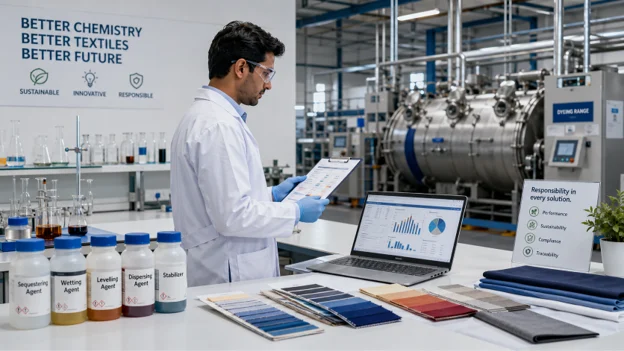
In textile manufacturing, chemical price is one of the most visible numbers in a purchasing decision. It appears clearly on quotations, comparisons, and cost sheets. But the performance of a textile chemical does not end at the purchase price. It continues inside the fabric, the machine, the water, the shade result, the rework risk, the delivery schedule, and the buyer's confidence.
Professional textile chemical selection should never be judged by price alone. A chemical might look cheaper at the beginning but become more expensive if it creates:
- Uneven processing
- Inconsistent absorbency
- Poor fabric preparation
- Higher reprocessing or correction work
- Excess water, steam, energy, or chemical use
- Delayed delivery
- Compliance uncertainty
For textile factories, especially in competitive export-oriented markets, the smarter question is not only about unit price. The stronger question is about production impact.
At Neno Biotech Co., Limited, this thinking is central to how we look at textile chemistry. A responsible textile chemical partner should help factories simplify complex chemical decisions and connect product selection with process performance, compliance confidence, and long-term production stability.
1. Price Is Visible. Process Cost Is Hidden.
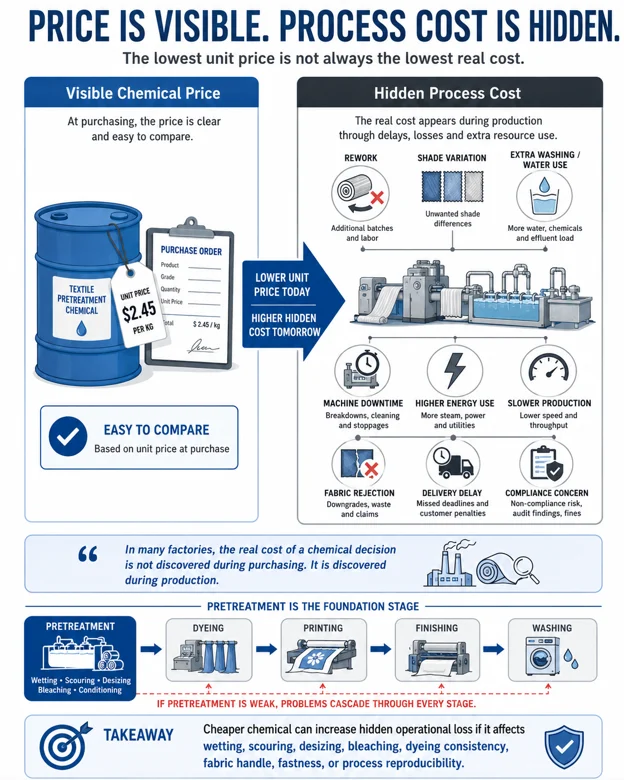
Chemical price is easy to compare because it is direct and visible. Process cost is harder to see because it is spread across different stages of production. It may appear as rework, shade variation, extra washing, machine downtime, higher energy use, slower production, fabric rejection, or pressure on delivery timelines.
A cheaper chemical can look attractive at the buying stage. But if it affects wetting, scouring, desizing, bleaching, dyeing consistency, fabric handle, fastness, or process reproducibility, the factory may pay the difference later through hidden operational losses.
This is especially important in pretreatment. Pretreatment is the foundation stage of textile processing. If fabric preparation is weak, the next stages become more difficult. Dyeing, printing, finishing, and washing all depend on how well the fabric was prepared before coloration or finishing begins.
2. Pretreatment Shows Why Chemical Selection Matters Early
Pretreatment is one of the clearest examples of why textile chemical selection is not only about price. In this stage, the fabric is prepared for the processes that follow. Good preparation supports absorbency, whiteness, cleanliness, uniformity, and process readiness.
If pretreatment is not stable, the impact may not remain limited to pretreatment. It can move forward into dyeing, printing, finishing, washing, and final quality. The factory may face uneven dyeing, poor shade repeatability, fabric defects, additional correction work, or unnecessary resource use.
That is why the selection of pretreatment auxiliaries should consider both chemical cost and process behavior. A better pretreatment solution should support cleaner preparation, smoother downstream processing, and more predictable production outcomes.
Neno Biotech Co., Limited develops and supplies textile auxiliary solutions across different stages of textile production, including Pretreatment Auxiliary Series. In this context, pretreatment is not just a technical step. It is a strategic step that protects the quality and confidence of the entire process.
3. The Right Chemical Supports Process Stability
Stable textile production depends on repeated performance. A factory does not only need a good result once. It needs reliable results again and again across batches, machines, operators, shades, fabric lots, and delivery schedules.
Chemical selection plays a direct role in this reliability. When a chemical supports consistent wetting, uniform preparation, controlled processing, stable dye uptake, or better washing performance, it helps the production team reduce uncertainty.
This is where the value of a textile chemical partner becomes larger than product supply. Technical understanding, product consistency, process support, and application knowledge all contribute to the factory's ability to run production with confidence.
In a modern textile factory, chemical selection should therefore be treated as a process decision, not only a purchase decision.
4. Chemical Decisions Also Affect Compliance Confidence
Textile manufacturing is increasingly connected with responsible chemical management. Buyers, brands, compliance teams, and factory management are paying closer attention to what enters the production process, not only what comes out at the end.
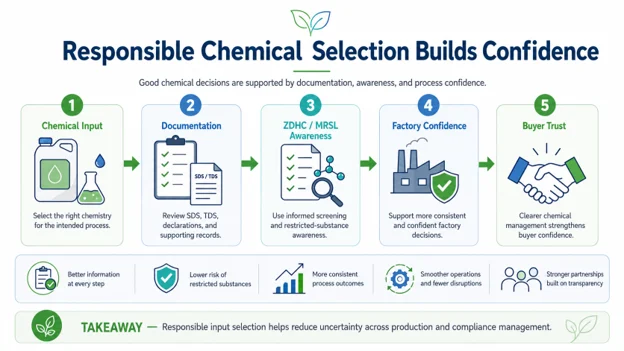
Frameworks such as the ZDHC Manufacturing Restricted Substances List (ZDHC MRSL) help the textile and apparel supply chain manage chemical inputs more responsibly. For chemical formulators and textile factories, this creates a stronger need to understand chemical conformance, documentation, product transparency, and safer input management.
For Neno Biotech Co., Limited, responsible chemical management is not treated as an extra decoration around the product. It is part of how a serious textile chemical partner is expected to work. Product selection, technical documentation, restricted-substance awareness, and buyer-facing confidence should move together as a normal standard of professional supply.
This does not mean compliance should be treated as only a certificate display. The real value of compliance-aware chemical selection is the confidence it gives to the production team, buyer-facing team, compliance department, and long-term customer relationship.
When a factory chooses chemicals with stronger compliance readiness, it is not only protecting one batch. It is protecting its production credibility.
5. Total Process Cost Is the Better Decision Lens
The lowest chemical price may reduce the purchase line, but the right chemical can protect the production line.
A stronger decision lens is total process cost. This means looking at how chemical selection affects the full production journey: preparation quality, machine efficiency, rework probability, water and energy use, shade consistency, delivery reliability, and compliance confidence.
For example, if a slightly better chemical reduces reprocessing, improves consistency, or helps the production team achieve a right-first-time result more often, the total value can be higher than the difference in unit price.
This is not a rejection of cost control. Cost matters. But responsible cost control should include both price and performance. A factory that understands this balance can make more professional decisions in a competitive textile market.
6. What Smart Factories Should Ask Before Selecting Textile Chemicals
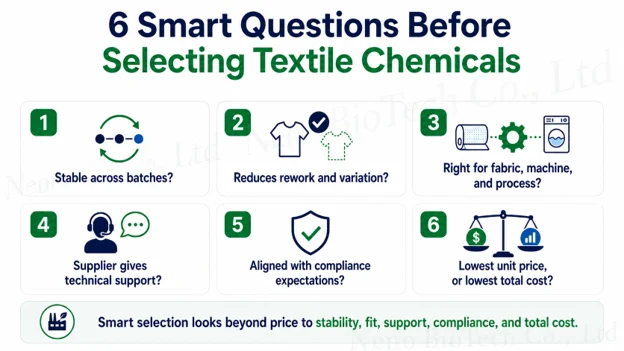
Before selecting a textile chemical only by price, factories can ask a few practical questions:
Does the chemical support stable processing across batches?
Will it help reduce rework, correction, or unnecessary process variation?
Is it suitable for the specific fabric, machine, process condition, and end-use expectation?
Does the supplier provide technical support and application understanding?
Is the product aligned with responsible chemical management and buyer compliance expectations?
Does the lowest unit price still remain lowest when total process impact is considered?
| Decision Area | What to Check | Why It Matters |
|---|---|---|
| Process stability | Batch-to-batch consistency and reproducibility | Reduces uncertainty and correction work |
| Fabric suitability | Fiber type, machine type, process condition, and end use | Prevents mismatch between product and process |
| Resource impact | Water, energy, washing, and processing time | Protects total production cost |
| Technical support | Supplier application knowledge and troubleshooting support | Helps solve problems before they become production losses |
| Compliance readiness | SDS, TDS, conformance documents, and buyer expectations | Supports responsible chemical management and customer confidence |
7. How Neno Biotech Looks at Textile Chemical Selection
Neno Biotech Co., Limited looks at textile chemistry as a practical bridge between product performance, process stability, responsible manufacturing, and customer trust.
Our work across textile auxiliary categories, including Pretreatment Auxiliary Series, is shaped by one simple understanding: factories need chemicals that do more than enter the process. They need chemical solutions that help the process run with confidence.
That is why chemical selection should not be reduced to price comparison alone. It should include technical suitability, production behavior, consistency, compliance awareness, and long-term value.
A responsible textile chemical partner does not only sell products. It helps factories think clearly about the process before problems appear in production.
Choose Process Confidence, Not Price Alone
Textile chemical selection is a business decision, a technical decision, and a trust decision at the same time.
Price will always matter. But in textile production, the lowest price is not always the lowest cost. The smarter decision is to evaluate how a chemical supports the full production process: pretreatment quality, process stability, rework reduction, resource efficiency, compliance confidence, and customer trust.
For factories that want stronger, more predictable, and more responsible textile production, the question is no longer only, "Which chemical is cheaper?"
The better question is: Which chemical helps us produce with more confidence?
FAQ
Why is textile chemical selection not only about price?
Because the real cost of a textile chemical includes its effect on process stability, rework, shade consistency, water and energy use, delivery reliability, and compliance confidence. A lower unit price can become more expensive if it increases hidden production costs.
What is total process cost in textile chemical selection?
Total process cost means evaluating the full production impact of a chemical, not only its purchase price per kilogram. It includes rework risk, machine efficiency, resource use, shade consistency, quality reliability, and compliance confidence.
Why is pretreatment important in textile processing?
Pretreatment prepares fabric for dyeing, printing, finishing, and washing. Stable pretreatment supports absorbency, cleanliness, whiteness, uniformity, and better downstream production confidence.
How does ZDHC compliance relate to textile chemical selection?
ZDHC-aware chemical selection helps the textile supply chain manage chemical inputs more responsibly. It gives factories stronger confidence in documentation, buyer expectations, and responsible chemical management.
What should factories ask before selecting textile chemicals?
Factories should ask whether the chemical supports stable batches, reduces rework, fits the fabric and process, comes with technical support, aligns with compliance expectations, and remains cost-effective when total process impact is considered.
Need Support Selecting Textile Auxiliaries?
NBT helps textile factories connect chemical selection with process performance, pretreatment quality, responsible chemical management, and production confidence.
Contact NBTReference note: This article uses general textile processing knowledge and responsible chemical management concepts. For ZDHC-related details, readers may also review the official ZDHC Roadmap to Zero MRSL and Gateway resources.